



Foundations for Future Human Settlements on Mars
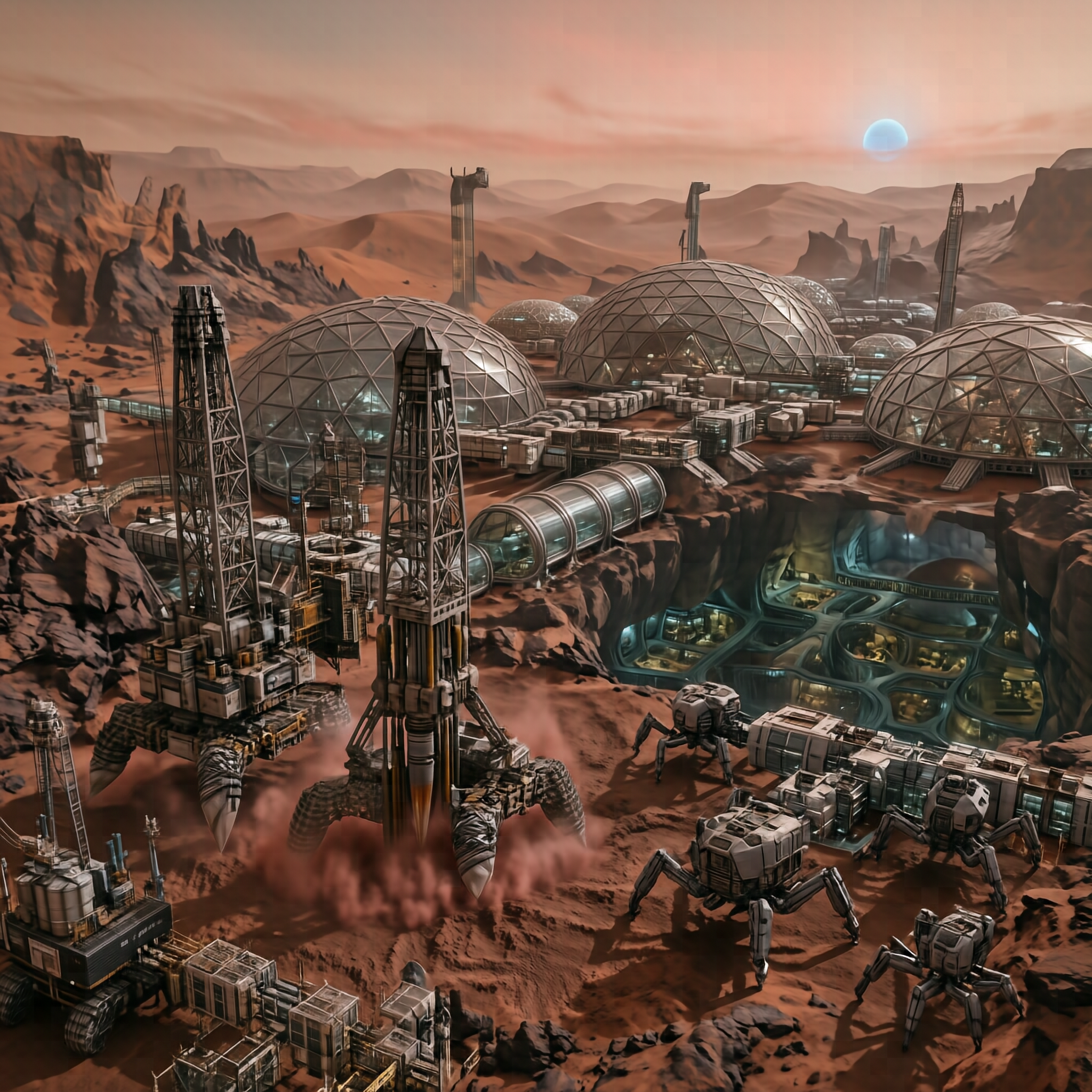

Martian Geotechnics is a specialized branch of Space Geotechnics that focuses on understanding, characterizing, and engineering the surface and subsurface conditions of Mars to support future human exploration, infrastructure development, and long-term settlement.
As international space agencies and private organizations accelerate plans for human missions to Mars, geotechnical engineering will become essential for ensuring the safety, stability, and sustainability of future Martian infrastructure. Every habitat, landing pad, transportation corridor, energy facility, and underground shelter will require a comprehensive understanding of Martian ground conditions.
Martian Geotechnics provides the scientific and engineering framework needed to investigate and utilize Martian soils and geological formations for future construction and resource development.
Understanding the Martian Surface
The surface of Mars is covered by a layer of regolith composed primarily of fragmented basaltic rock, dust, volcanic materials, and weathered geological deposits formed through aeolian, impact, and mass-wasting processes. Unlike Earth, Martian soils have evolved under unique environmental conditions that significantly influence their geotechnical and engineering behavior. Current investigations from the InSight and Perseverance missions indicate that Martian regolith is predominantly composed of sand-sized basaltic particles with measurable cohesion and layered subsurface structures that affect excavation, mobility, and infrastructure development.
Key characteristics of the Martian environment include:
• Reduced gravity, which influences soil strength, stress distribution, and the performance of foundations and excavation systems.
• Thin atmosphere, resulting in extremely low surface pressure and affecting construction methods, material curing, and heat transfer processes.
• Extreme temperature fluctuations, causing thermal cycling that can impact structural durability and long-term infrastructure performance
• Global dust storms, which modify surface temperatures, influence atmospheric-regolith interactions, and affect seasonal water-ice accumulation.
• Presence of subsurface ice, a critical factor for both resource utilization and geotechnical stability, particularly in higher-latitude regions.
• Radiation exposure, which presents challenges for long-term human habitation and necessitates protective shielding using local regolith resources.
• Limited water availability, despite evidence of atmosphere-regolith water exchange and localized subsurface water reservoirs that may support future exploration activities.
These conditions create unique challenges for geotechnical investigations and infrastructure design. Although Martian regolith offers significant potential as an in-situ construction material, its engineering performance is strongly influenced by low gravity, atmospheric conditions, thermal cycling, and water-ice interactions. Furthermore, the limited availability of direct geotechnical measurements on Mars continues to constrain the development of reliable design methodologies for future extraterrestrial infrastructure.

Engineering Challenges on Mars
Future infrastructure projects on Mars will face numerous geotechnical and environmental challenges. Mars infrastructure development is complicated by reduced gravity, uncertain subsurface conditions, mobile dust, altered excavation mechanics, and the presence of subsurface ice deposits.
Foundation Design
Habitats and industrial facilities must be supported by foundations capable of performing under reduced gravity and uncertain subsurface conditions. Foundation design on Mars is constrained by limited site investigation data, variable regolith stratigraphy, and gravity-dependent soil behavior. Available mission observations suggest that near-surface regolith is generally sand-like with low to moderate cohesion and internal friction angles ranging from approximately 30° to 40°, while density and strength may increase with depth due to compaction. Consequently, reliable foundation design will require site-specific geotechnical characterization and continuous refinement as additional in-situ data become available.
Dust and Surface Stability
Martian dust is extremely fine and can affect construction operations, equipment performance, and infrastructure durability. The combination of low gravity and a thin atmosphere significantly alters particle transport processes compared with Earth. Research indicates that saltation can initiate more easily under Martian conditions, contributing to widespread dust movement and surface modification (Musiolik et al., 2018). Furthermore, seasonal carbon dioxide frost deposition and sublimation can disturb surface materials, maintain mobile dust layers, and reduce surface stability in certain regions. These processes present important challenges for construction activities, transportation systems, and long-term infrastructure maintenance.
Excavation and Underground Construction
Future settlements may require underground structures for protection against radiation, temperature extremes, dust storms, and meteorite impacts. Understanding excavation behavior and ground stability will therefore be critical. Martian excavation operations differ significantly from terrestrial practices because reduced gravity decreases reaction forces and excavation traction, requiring specialized excavation systems and operational strategies. In addition, underground construction stability depends on local rock mass characteristics and subsurface geological conditions. Studies suggest that conventional Earth-based rock mass classification systems may require modification to accurately represent Martian conditions. Properly designed underground facilities could provide substantial protection against environmental hazards while supporting long-term human habitation.
Ice-Rich Soils
Many regions of Mars contain subsurface ice deposits. These materials may influence settlement behavior, bearing capacity, and long-term infrastructure performance. Orbital observations, rover investigations, and radar measurements have confirmed the presence of extensive shallow ice deposits and layered subsurface structures across many mid- and high-latitude regions of Mars. The engineering behavior of these soils depends on whether the ice exists as pore-filling ice, massive ice bodies, or actively sublimating deposits. Variations in ice content can significantly affect ground strength, deformation characteristics, and long-term infrastructure stability, making detailed subsurface investigations essential before construction activities begin.
Overall, successful infrastructure development on Mars will depend on understanding the combined effects of uncertain stratigraphy, mobile dust, excavation challenges, and spatially variable ice deposits. These factors make conservative, site-specific geotechnical design essential for future Martian settlements and infrastructure systems.

Martian Regolith Characterization
One of the primary objectives of Martian Geotechnics is the characterization of Martian regolith and subsurface materials. Regolith characterization is essential because the physical, mechanical, thermal, and volatile-related properties of Martian soils directly influence landing safety, rover mobility, excavation performance, foundation design, and long-term infrastructure development. Although significant progress has been made through orbital observations, rover missions, and laboratory simulations, substantial uncertainties remain regarding subsurface heterogeneity, ice distribution, and in-situ geotechnical properties across Mars.
Important engineering properties include:
-
Particle Size Distribution
Particle size distribution strongly influences the geomechanical, thermal, and processing behavior of Martian regolith. Studies from the InSight and Mars 2020 missions indicate that Martian soils are predominantly composed of fine basaltic sand, with particle sizes typically ranging from approximately 0.15 to 0.25 mm, although coarser materials up to 1–2 mm have also been identified in Jezero Crater. Variations in grain size significantly affect strength, trafficability, thermal response, and construction performance.
-
Density and Porosity
Density and porosity are among the most important controls on regolith behavior. Experimental studies demonstrate that density strongly affects penetration resistance, shear strength, compressibility, and bearing capacity. Evidence from mission observations suggests that regolith density generally increases with depth due to compaction processes, resulting in varying engineering behavior between shallow and deeper soil layers .
-
Shear Strength
Shear strength governs slope stability, excavation resistance, foundation performance, and rover mobility. Research on Martian regolith simulants indicates that cohesion and shear strength increase significantly with bulk density and are influenced by particle size distribution. Direct shear testing on Martian soil simulants has reported cohesion values below 5 kPa and internal friction angles ranging between approximately 39° and 41°, indicating relatively strong frictional behavior despite limited cohesion.
-
Compressibility
Compressibility influences settlement behavior and structural stability. Laboratory investigations show that Martian regolith simulants generally exhibit low compressibility and limited swelling potential; however, soil response remains highly dependent on density, moisture content, and particle arrangement. Accurate assessment of compressibility is essential for designing foundations, landing pads, and surface infrastructure.
-
Thermal Properties
Thermal properties, including thermal conductivity and thermal inertia, play a critical role in habitat design, energy management, and subsurface investigations. Measurements from the InSight mission have demonstrated strong relationships between thermal behavior, particle size, density, and soil cohesion. Understanding heat transfer within the regolith is essential for infrastructure resilience under extreme Martian temperature fluctuations.
-
Ice Content
The distribution and abundance of subsurface ice are major factors influencing Martian geotechnical conditions. Radar observations from the Tianwen-1 and Zhurong missions reveal significant subsurface heterogeneity and suggest that ice distribution varies considerably between regions. Ice-rich soils may exhibit different strength, deformation, and thermal characteristics compared with dry regolith, making ice detection a priority for future exploration and construction projects.
-
Bearing Capacity
Bearing capacity determines the ability of Martian soils to support foundations, landing systems, transportation infrastructure, and heavy equipment. Experimental studies demonstrate that bearing capacity is strongly influenced by density, compaction state, and pressure-sinkage behavior. Recent mission-based investigations increasingly use rover tools and penetration systems to derive geotechnically meaningful estimates of terrain strength and load-bearing performance directly on Mars.
-
Dust Transport Mechanisms
Dust transport remains one of the most dynamic processes affecting the Martian surface. Wind-driven sediment transport, atmospheric activity, and modern volatile interactions continuously modify surface conditions and influence infrastructure durability. Recent observations indicate that soil crust formation, dust mobilization, and atmosphere-regolith interactions remain active processes that continue to alter surface properties on present-day Mars.
Accurate characterization of these properties is essential for safe and efficient infrastructure development. A comprehensive understanding of grain size, density, strength, thermal behavior, ice distribution, bearing capacity, and dust transport mechanisms enables engineers to design foundations, habitats, transportation systems, and resource-utilization technologies capable of operating reliably in the challenging Martian environment.
Applications of Martian Geotechnics
Martian Geotechnics supports a broad range of future engineering applications that are essential for the establishment of long-term human settlements on Mars. By providing the knowledge required to understand soil behavior, subsurface conditions, and regolith-based construction techniques, Martian geotechnics serves as a foundation for habitat development, transportation systems, resource utilization, and infrastructure resilience.
-
Martian Habitat Foundations
Future habitats, research stations, and industrial facilities will require foundation systems capable of supporting structural loads under reduced gravity and variable subsurface conditions. Current studies suggest that shallow foundation systems combined with comprehensive site characterization may offer practical solutions for early settlements. Advanced geotechnical investigation tools, including penetrometers, bearing plates, and in-situ testing systems, can provide critical information for foundation selection and quality control during construction.
-
Landing Pads and Spaceports
Landing pads and spaceports represent some of the most important applications of Martian geotechnics. Infrastructure constructed from locally available regolith can serve as durable launch and landing surfaces while simultaneously functioning as structural foundation platforms. Engineered landing pads can significantly reduce dust generation, surface erosion, cratering, and debris impacts caused by rocket exhaust during landing and takeoff operations, improving both safety and operational efficiency.
-
Underground Shelters
Underground structures offer a practical solution for protecting future Martian settlers from radiation, meteorite impacts, dust storms, and extreme temperature fluctuations. Geotechnical investigations indicate that tunneling and underground construction may be feasible within many Martian geological formations, provided that local rock mass conditions and subsurface stability are carefully evaluated. Underground shelters can also provide natural thermal insulation, reducing energy requirements for long-term habitation.
-
Transportation Infrastructure
Reliable transportation networks will be essential for connecting habitats, industrial facilities, landing zones, and resource extraction sites. Martian geotechnics plays a crucial role in the design of roads, access routes, surface platforms, and transportation corridors. Understanding regolith strength, bearing capacity, and deformation characteristics is necessary to ensure the long-term performance of vehicles and transportation systems operating on the Martian surface.
-
Energy Production Facilities
Future settlements will require energy generation and storage facilities capable of operating under harsh environmental conditions. Solar farms, nuclear power installations, and energy storage systems will depend on properly engineered foundations and ground stabilization measures. Geotechnical site investigations will help identify suitable locations and ensure infrastructure stability throughout the operational life of these facilities .
-
Resource Extraction Systems
In-Situ Resource Utilization (ISRU) is considered a cornerstone of sustainable Martian exploration. Resource extraction systems designed to recover water, oxygen, construction materials, and other critical resources depend heavily on accurate characterization of regolith and subsurface conditions. Geotechnical knowledge supports drilling operations, excavation planning, material handling, and the development of large-scale ISRU facilities.
-
Regolith-Based Construction Materials
One of the most promising applications of Martian geotechnics is the transformation of local regolith into construction materials. Research has demonstrated the potential of geopolymer-based materials, sulfur-regolith concrete, and additive manufacturing technologies for producing habitats and infrastructure using locally available resources. Sulfur-regolith concrete and Marscrete formulations have shown encouraging mechanical performance, while geopolymer systems remain among the most promising candidates for large-scale construction applications.
-
Ground Stabilization Techniques
Ground stabilization will be necessary in areas with weak, loose, or highly erodible regolith. Emerging technologies such as biocementation, enzyme-induced stabilization, and biopolymer-based soil treatment have demonstrated potential for improving soil strength, reducing dust generation, and enhancing long-term infrastructure performance. Although these techniques require further validation under Martian environmental conditions, they may become key tools for future construction and maintenance activities.
These applications will play a vital role in transforming Mars from an exploration destination into a permanent human settlement. By enabling safe foundations, resilient infrastructure, efficient resource utilization, and sustainable construction practices, Martian geotechnics forms one of the fundamental engineering disciplines required for the future colonization of the Red Planet.

Future Research Directions
Research in Martian Geotechnics continues to expand as new data becomes available from robotic missions and planetary exploration programs.
Key research areas include:
• Martian soil mechanics
• Ice-soil interaction behavior
• Autonomous geotechnical investigations
• In-situ testing technologies
• Regolith-based construction methods
• Ground improvement techniques
• Numerical modeling of Martian soils
Advances in these fields will support future engineering activities and infrastructure development on Mars.
The Future of Martian Infrastructure
The long-term vision for Mars includes self-sustaining settlements, transportation systems, industrial facilities, and scientific research centers.
Achieving this vision will require extensive geotechnical knowledge and innovative engineering solutions specifically adapted to Martian conditions. Understanding the behavior of Martian soils and geological formations will be fundamental to the success of future infrastructure projects.
Martian Geotechnics represents one of the most important engineering disciplines for enabling sustainable human presence on the Red Planet.
Conclusion
As humanity moves closer to establishing a permanent presence on Mars, the importance of understanding Martian ground conditions continues to grow. Martian Geotechnics provides the foundation for safe construction, infrastructure resilience, and sustainable development in one of the most challenging environments ever encountered by engineers.
Through continued research and innovation, Martian Geotechnics will help transform the vision of human settlement on Mars into reality.
