



The Solar System at a Glance | Planets, Moons and Space Exploration
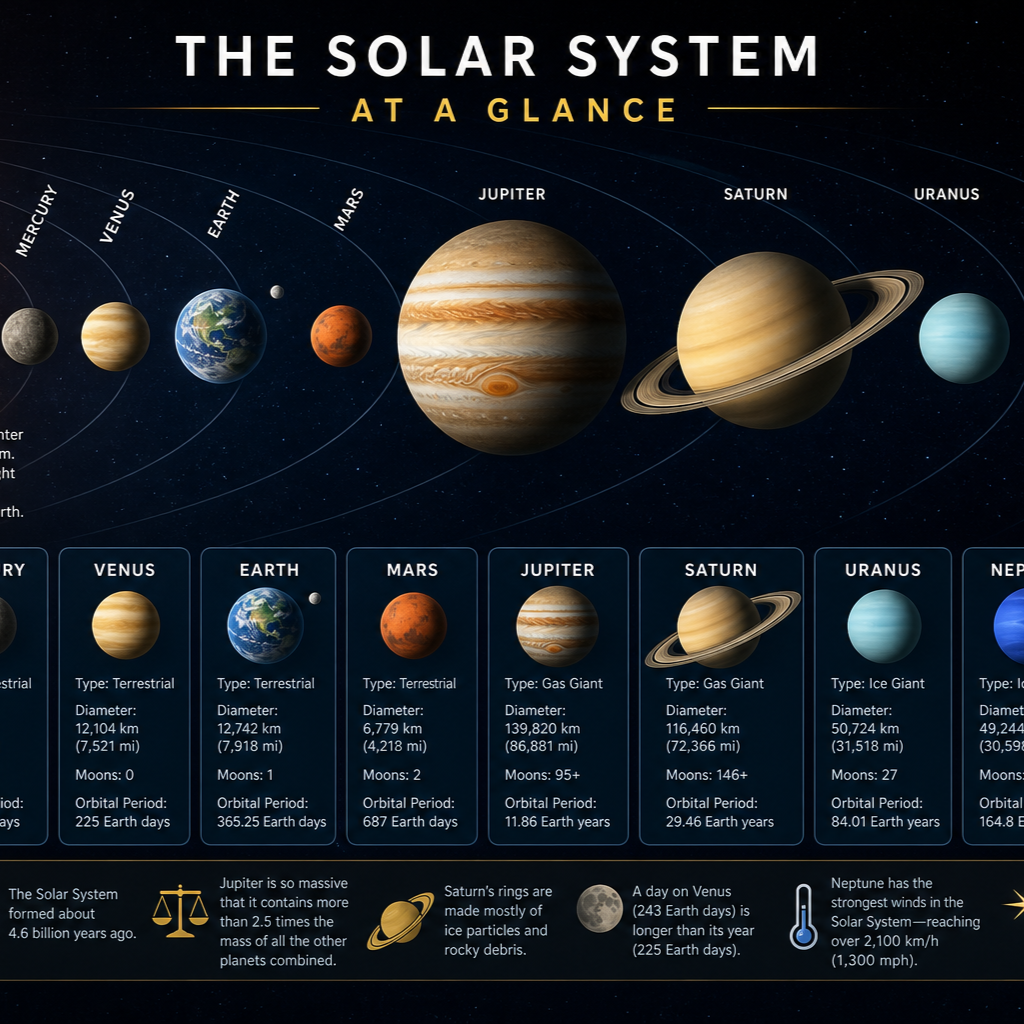
The Solar System at a Glance
An Overview of Our Cosmic Neighborhood
The Solar System is the vast planetary system that surrounds our Sun and serves as humanity's home in the universe. Formed approximately 4.6 billion years ago from a collapsing cloud of gas and dust, it consists of the Sun, eight planets, their moons, dwarf planets, asteroids, comets, and countless smaller celestial bodies.
At the center of the Solar System lies the Sun, a massive star that contains more than 99% of the system's total mass. Its gravitational influence keeps planets and other objects in orbit, while its energy provides the light and heat necessary for life on Earth.
The planets of the Solar System are divided into two main groups. The inner planets, Mercury, Venus, Earth, and Mars, are rocky worlds with solid surfaces. The outer planets, Jupiter, Saturn, Uranus, and Neptune, are much larger and consist primarily of gases and ice.
The Inner Planets
Mercury
Mercury is the smallest planet in the Solar System and the closest to the Sun. Its heavily cratered surface resembles Earth's Moon, and it experiences extreme temperature variations due to its lack of a significant atmosphere.
Venus
Often called Earth's twin because of its similar size, Venus is covered by a dense atmosphere composed mainly of carbon dioxide. It is the hottest planet in the Solar System due to an intense greenhouse effect.
Earth
Earth is the only known planet to support life. Its atmosphere, liquid water, and moderate climate create conditions that allow a diverse range of ecosystems to thrive.
Mars
Known as the Red Planet, Mars has fascinated scientists for decades. Evidence suggests that liquid water once existed on its surface, making it one of the most promising locations in the search for past or present extraterrestrial life.
The Outer Planets
Jupiter
Jupiter is the largest planet in the Solar System. This gas giant possesses a powerful magnetic field, dozens of moons, and the famous Great Red Spot, a massive storm that has persisted for centuries.
Saturn
Saturn is renowned for its spectacular ring system. Although composed primarily of hydrogen and helium, Saturn is less dense than water and hosts numerous moons, including Titan.
Uranus
Uranus is an ice giant distinguished by its unusual axial tilt, causing it to rotate almost on its side. Its atmosphere contains methane, giving the planet its blue-green appearance.
Neptune
The most distant planet from the Sun, Neptune is known for its powerful winds and deep blue color. It remains one of the least explored planets in the Solar System.
Beyond the Planets
The Solar System contains many additional objects beyond the eight major planets.
Dwarf Planets
Dwarf planets such as Pluto, Eris, Haumea, and Makemake occupy regions beyond Neptune and provide valuable insights into the early formation of the Solar System.
Asteroids
Most asteroids are found within the Asteroid Belt between Mars and Jupiter. These rocky bodies are remnants of the Solar System's formation.
Comets
Comets are icy objects that originate from the outer Solar System. As they approach the Sun, they develop glowing comas and tails that can stretch millions of kilometers across space.
The Future of Solar System Exploration
Humanity's exploration of the Solar System continues to accelerate through robotic missions, advanced telescopes, and ambitious plans for lunar and Martian settlements. Future missions may establish permanent bases on the Moon, send humans to Mars, and unlock new scientific discoveries throughout the Solar System.
Understanding the Solar System not only helps us learn about our cosmic origins but also provides the foundation for future exploration, infrastructure development, and human expansion beyond Earth.