



Major Space Agencies
Major Space Agencies
The Organizations Shaping the Future of Space Exploration
Space exploration is driven by a combination of government agencies, international partnerships, and private organizations working to expand humanity's presence beyond Earth. These agencies lead missions to the Moon, Mars, and deep space while advancing scientific research, satellite technology, and future space infrastructure.
NASA
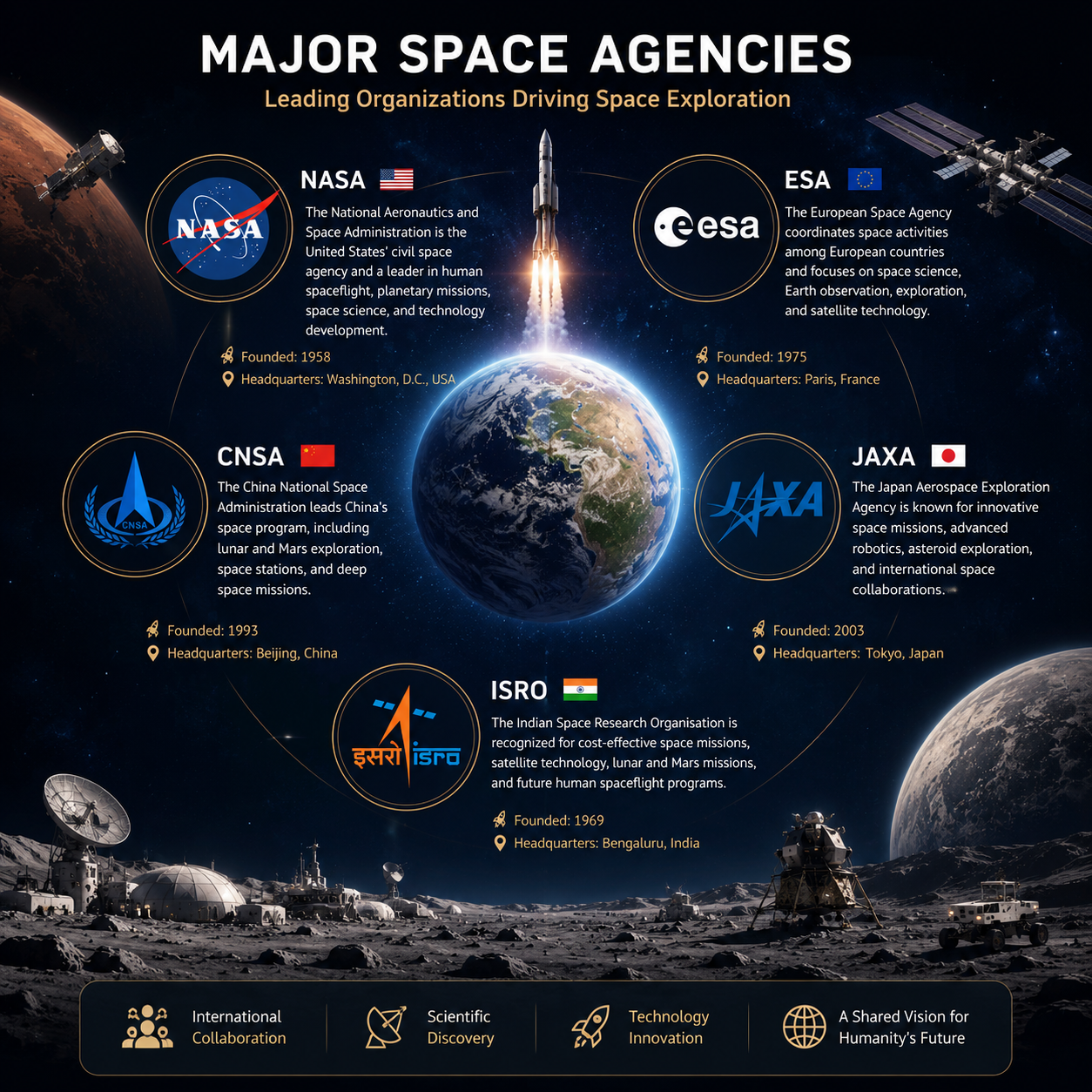
The National Aeronautics and Space Administration (NASA) is the world's most recognized space agency and has played a leading role in space exploration since its establishment in 1958.
NASA's achievements include the Apollo Moon landings, the Space Shuttle Program, Mars rover missions, the International Space Station, and the Artemis Program, which aims to return humans to the Moon and prepare for future missions to Mars.
Key Focus Areas
- Human Spaceflight
- Moon Exploration
- Mars Exploration
- Space Science
- Planetary Research
- Space Technology Development
European Space Agency
The European Space Agency (ESA) is an international organization composed of multiple European member states. ESA coordinates scientific, technological, and exploration missions across Europe.
The agency has contributed to numerous missions involving Earth observation, planetary exploration, space science, and human spaceflight. ESA is also a major partner in the Artemis Program and future lunar exploration initiatives.
Key Focus Areas
- Earth Observation
- Lunar Exploration
- Space Science
- Satellite Technology
- International Cooperation
China National Space Administration
The China National Space Administration (CNSA) has rapidly become one of the world's most ambitious space organizations. China's space program has achieved major milestones, including lunar exploration missions, Mars exploration, and the development of its own space station.
Recent achievements include the Chang'e lunar missions and the Tianwen Mars exploration program.
Key Focus Areas
- Lunar Exploration
- Mars Exploration
- Space Stations
- Planetary Science
- Deep Space Missions
Japan Aerospace Exploration Agency
Japan Aerospace Exploration Agency (JAXA) is known for its advanced robotic missions, asteroid sample-return projects, and innovative space technologies.
JAXA has successfully conducted missions to asteroids and participates in numerous international exploration programs focused on the Moon and deep space.
Key Focus Areas
- Asteroid Exploration
- Robotics
- Lunar Missions
- Space Science
- Advanced Engineering
Indian Space Research Organisation
The Indian Space Research Organisation (ISRO) has emerged as a major contributor to global space exploration through cost-effective and highly successful missions.
ISRO's achievements include lunar exploration missions, Mars exploration, satellite development, and future human spaceflight programs.
Key Focus Areas
- Lunar Exploration
- Mars Missions
- Satellite Technology
- Human Spaceflight
- Planetary Research
International Collaboration in Space
Modern space exploration increasingly relies on international cooperation. Large-scale projects such as the International Space Station, Artemis Program, lunar infrastructure development, and future Mars missions require collaboration among agencies, research institutions, and industry partners worldwide.
These organizations are helping shape the future of human exploration, scientific discovery, and infrastructure development beyond Earth.
Why Space Agencies Matter for Space Geotechnics
Future lunar and Martian settlements will depend on detailed knowledge of planetary surfaces and subsurface conditions. Space agencies are generating the scientific data that enables researchers and engineers to develop new solutions in lunar geotechnics, Martian geotechnics, planetary soil mechanics, and extraterrestrial infrastructure engineering.
As humanity moves toward permanent presence beyond Earth, collaboration between space agencies and engineering disciplines such as Space Geotechnics will become increasingly important.