



What is Regolith? | Understanding Planetary Surface Materials
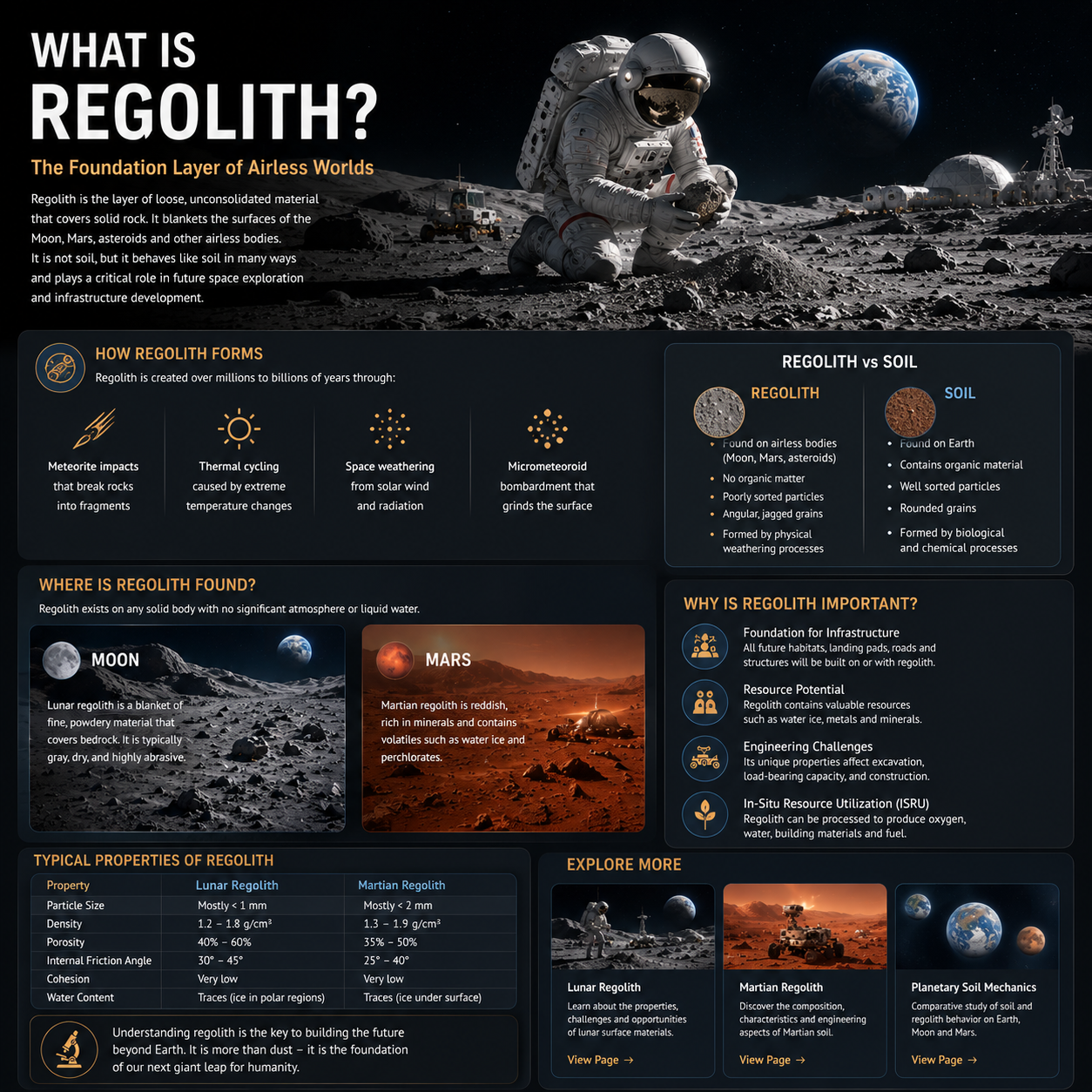
What is Regolith?
Regolith is the loose layer of unconsolidated material that covers the solid bedrock of planetary bodies such as the Moon, Mars, asteroids, and other rocky worlds. Unlike soil on Earth, regolith contains no organic matter and is formed through geological and space-related processes such as meteorite impacts, volcanic activity, thermal fracturing, and space weathering.
What Does Regolith Mean?
- The loose surface material covering solid rock.
- Found on the Moon, Mars, asteroids, and many other planetary bodies.
- Includes dust, sand, broken rock fragments, and impact-generated particles.
- The primary material engineers interact with during extraterrestrial construction.
Why is Regolith Important?
Regolith is one of the most important materials in planetary exploration. Every spacecraft landing, rover mission, habitat foundation, excavation project, and future space settlement depends on understanding the engineering properties of regolith.
Its mechanical behavior directly affects:
- Landing pad stability
- Habitat foundation design
- Rover mobility
- Excavation and mining operations
- Road and infrastructure construction
- Radiation shielding
- In-Situ Resource Utilization (ISRU)
Lunar Regolith
Lunar regolith is produced primarily by billions of years of meteorite impacts. It consists of highly angular rock fragments, fine dust, mineral grains, and impact glass. The absence of an atmosphere and liquid water has preserved these materials for billions of years, creating unique engineering challenges for future lunar infrastructure.
Martian Regolith
Martian regolith differs significantly from lunar regolith. It has been shaped by volcanic activity, wind erosion, ancient water flows, and seasonal climate processes. It also contains iron oxides, giving Mars its distinctive red appearance, and in some regions includes subsurface water ice and perchlorates.
Regolith and Space Geotechnics
Understanding regolith is fundamental to Space Geotechnics. Engineers must evaluate its bearing capacity, density, shear strength, compressibility, and excavation behavior before designing foundations, habitats, roads, landing pads, and other infrastructure on the Moon and Mars.
Earth Soil vs Regolith
Earth Soil contains organic matter, microorganisms, and water that support plant life.
Regolith contains no biological material and is formed entirely through geological and extraterrestrial processes, making its engineering behavior fundamentally different from terrestrial soils.