



Geotechnical Site Investigation on the Moon and Mars
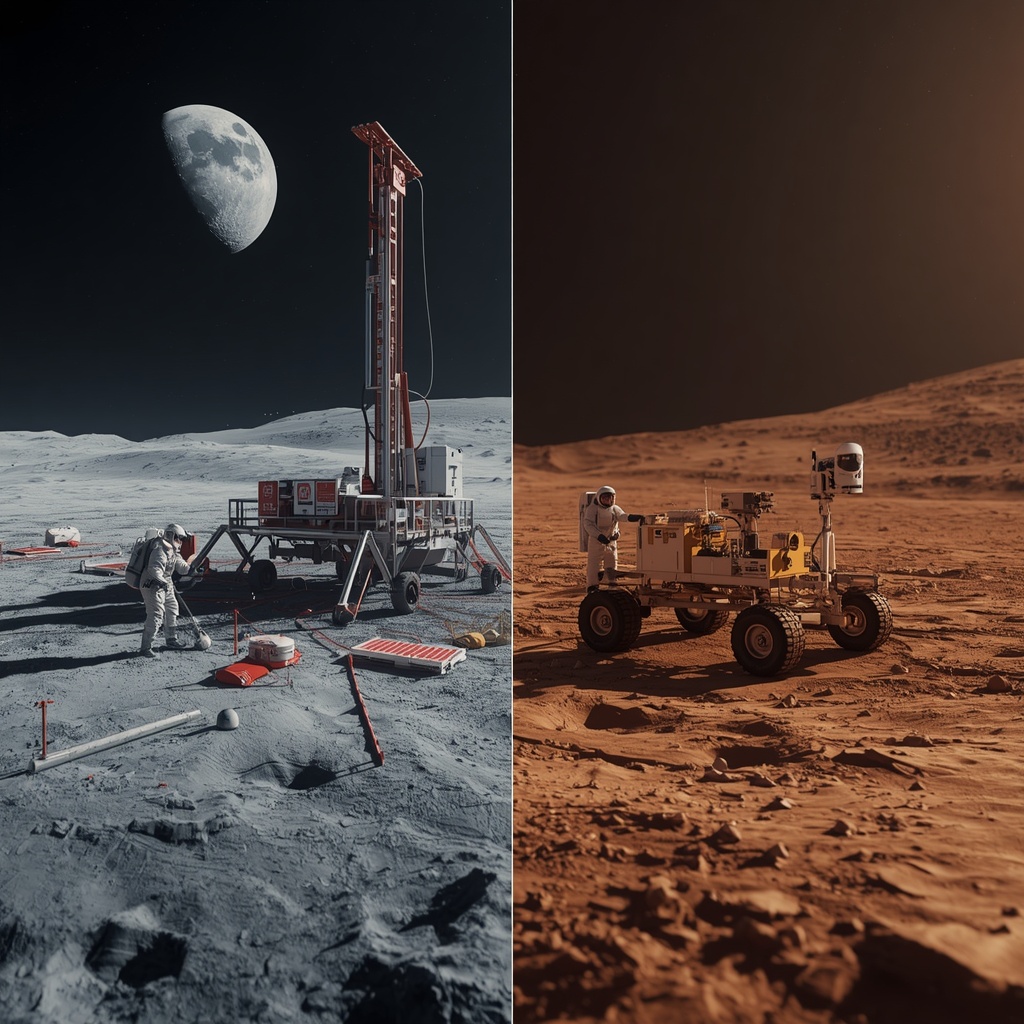
Geotechnical Site Investigation on the Moon and Mars
Geotechnical site investigation is the first and most essential step in designing safe and reliable infrastructure on the Moon and Mars. Before constructing habitats, landing pads, transportation networks, or underground facilities, engineers must understand the physical, mechanical, and geological characteristics of the planetary subsurface.
Unlike terrestrial investigations, planetary geotechnical investigations rely on a combination of robotic exploration, in situ measurements, returned sample analysis, laboratory testing using regolith simulants, remote sensing, and advanced numerical modeling. Together, these approaches provide critical information for future lunar and Martian exploration, construction, and In-Situ Resource Utilization (ISRU).
Why is Geotechnical Site Investigation Important?
Reliable site investigation minimizes engineering uncertainty and provides the information required to safely design extraterrestrial infrastructure. Understanding subsurface conditions directly influences mission safety, construction feasibility, and long-term habitat performance.
- Habitat foundation design
- Landing pad construction
- Road and transportation planning
- Excavation and trenching
- Underground construction
- Resource extraction (ISRU)
- Assessment of geological hazards
In Situ Investigation Techniques
Since the Apollo and Surveyor missions, numerous techniques have been developed to investigate planetary soils. Historical lunar missions employed penetrometers, soil scoops, drills, trench excavations, and nuclear densiometers, while Mars missions have relied on rover wheel tracks, lander footpad penetrations, trenching, and surface observations. More recently, missions such as NASA's InSight have combined orbital observations with laboratory simulations to estimate subsurface mechanical and thermophysical properties before landing.
Modern Site Investigation Methods
- Ground Penetrating Radar (GPR)
- Penetrometers and Cone Penetration Testing (CPT)
- Robotic drilling systems
- Seismic surveys
- Orbital remote sensing
- Wheel–terrain interaction analysis
- Sample collection and laboratory analysis
- Digital terrain modeling and AI-assisted interpretation
Key Geotechnical Parameters
Site investigations aim to determine the engineering properties that control the behavior of planetary regolith during construction and exploration.
- Regolith thickness
- Particle size distribution
- Bulk density
- Porosity
- Bearing capacity
- Shear strength
- Internal friction angle
- Cohesion
- Compressibility
- Thermal properties
- Ice content (Mars)
Lunar Site Investigation
Lunar investigations focus primarily on characterizing the thickness, density, and mechanical behavior of lunar regolith. Recent Chang'e-4 and Chang'e-6 missions have provided valuable information on particle morphology, cohesion, internal friction angle, and stratigraphy, significantly improving our understanding of the Moon's subsurface. These findings are essential for foundation engineering, excavation, rover mobility, and future lunar infrastructure development.
Martian Site Investigation
Martian geotechnical investigations are more complex because the surface has been shaped by volcanic activity, wind erosion, ancient water processes, and seasonal environmental changes. Current evidence suggests that the upper regolith consists largely of loose basaltic sand, while deeper layers may contain larger rock fragments and subsurface ice. Understanding these materials is fundamental for future human missions and long-term settlement.
Regolith Simulants and Numerical Modeling
Because authentic lunar and Martian samples are extremely limited, researchers rely on high-quality regolith simulants for laboratory experiments. Numerical modeling, discrete element simulations, and digital twins are increasingly used to predict penetration resistance, bearing capacity, excavation behavior, and rover mobility under reduced gravity conditions. Standardizing laboratory testing procedures remains an important challenge for future planetary geotechnical research.
Future Directions
Future planetary site investigations will integrate autonomous robotics, artificial intelligence, machine learning, advanced drilling systems, seismic monitoring, and geophysical exploration to provide comprehensive subsurface characterization. These technologies will enable safer habitat construction, efficient ISRU operations, and sustainable human settlements on the Moon and Mars.
Related Topics
- What is Regolith?
- Lunar Regolith
- Martian Regolith
- Foundation Engineering for Lunar and Martian Structures
- Bearing Capacity of Lunar and Martian Regolith
- Planetary Soil Mechanics