



Landing Pad and Surface Infrastructure Design
Landing Pad and Surface Infrastructure Design
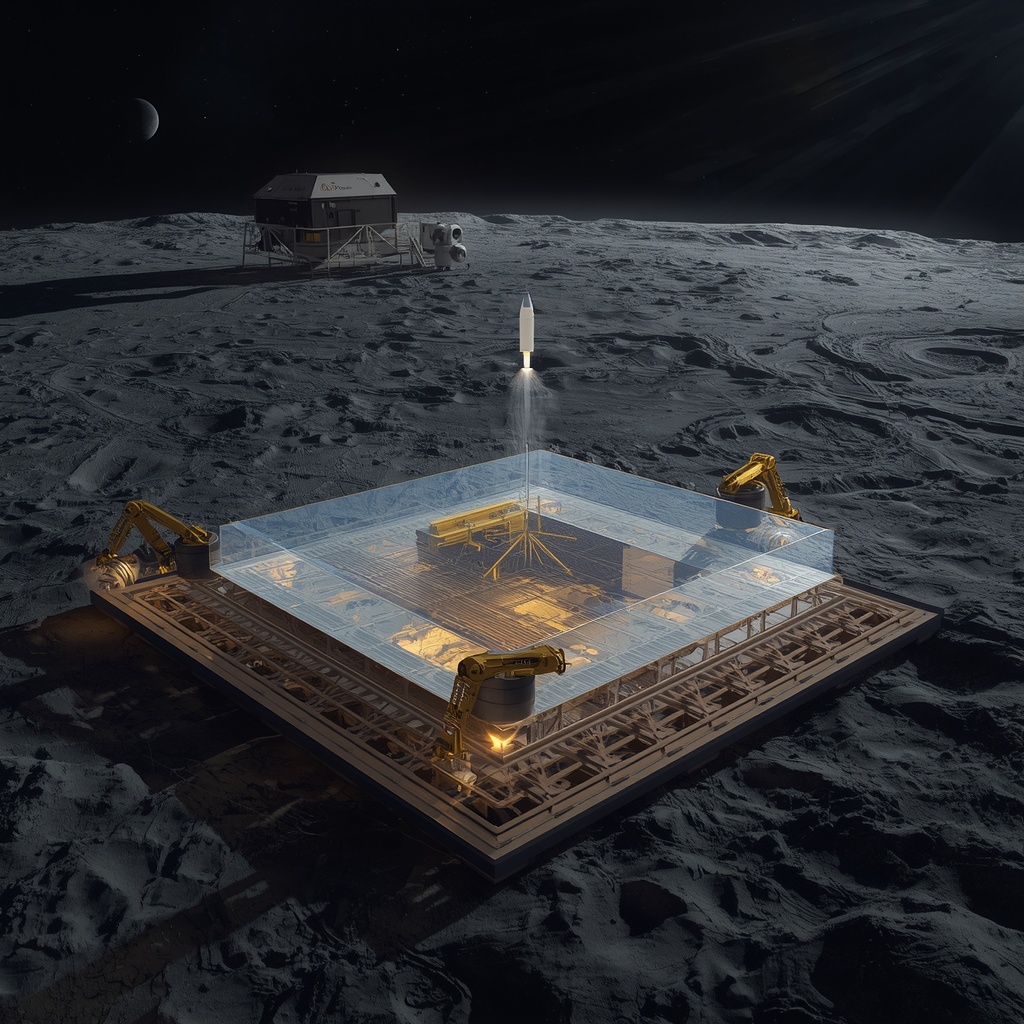
Landing pad and surface infrastructure design is a fundamental component of Space Geotechnics. Future missions to the Moon and Mars will require durable landing pads capable of protecting spacecraft, nearby infrastructure, and astronauts from the destructive effects of rocket exhaust plume interactions with planetary regolith.
Unlike Earth, where prepared runways and launch facilities already exist, extraterrestrial landing systems must be constructed directly from local materials. Rocket exhaust can excavate loose regolith, eject high-speed particles, create craters, and threaten surrounding habitats. Consequently, engineered landing pads are expected to become essential infrastructure for long-term lunar and Martian settlements.
Why Landing Pads are Essential
Landing pads provide a stable and predictable surface for spacecraft while significantly reducing dust generation and surface erosion.
- Reduce rocket plume erosion
- Minimize high-velocity regolith ejecta
- Protect habitats and equipment
- Improve landing safety
- Enable reusable spaceports
- Support sustainable human settlements
Plume–Surface Interaction
During landing or launch, rocket exhaust interacts directly with loose lunar or Martian regolith. High-temperature gases accelerate soil particles to extremely high velocities, producing craters beneath the spacecraft while ejecting dust and rocks over long distances.
On the Moon, where there is no atmosphere, dust particles may travel at several kilometers per second, posing serious risks to nearby infrastructure. On Mars, plume excavation may expose buried ice, destabilize the landing surface, and increase the risk of lander tilting.
Landing Pad Construction Methods
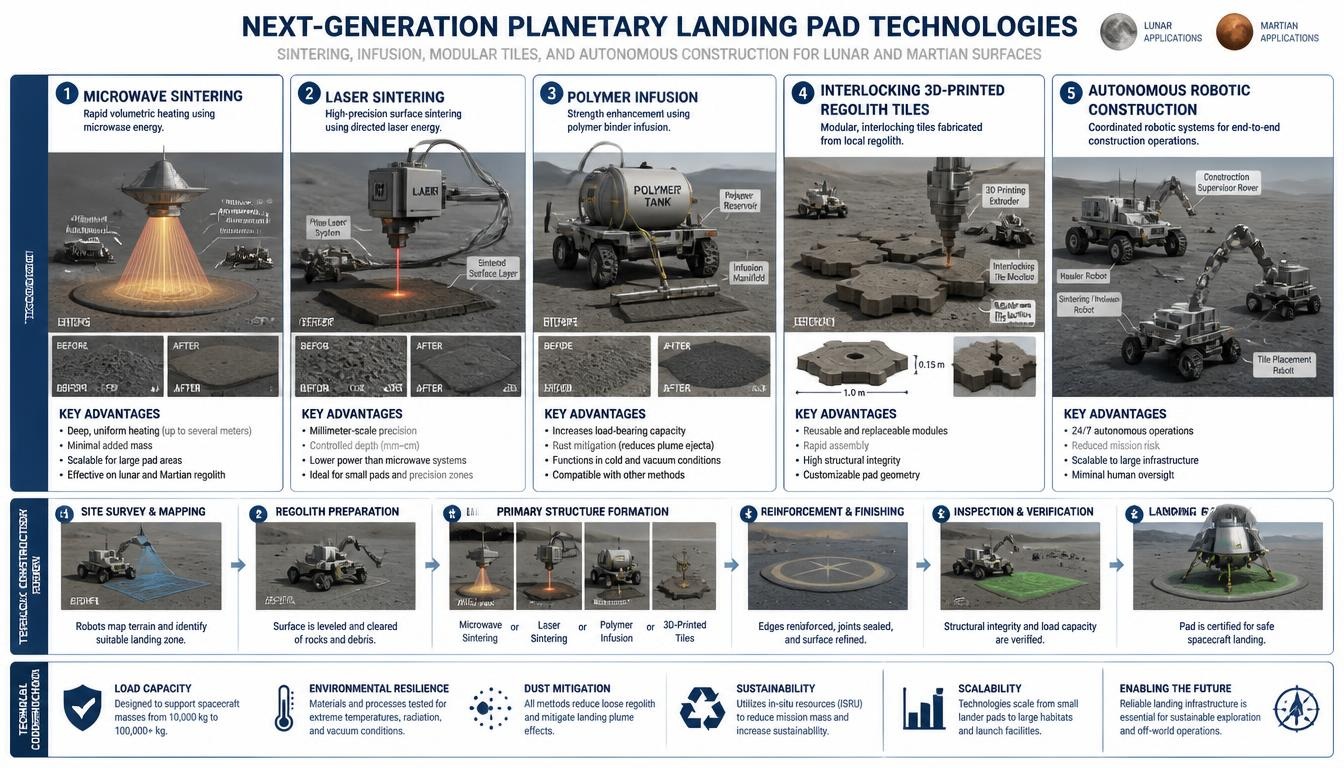
Several technologies are currently being investigated for constructing extraterrestrial landing pads using locally available resources.
- Microwave sintering of regolith
- Laser sintering
- Polymer-infused regolith composites
- 3D-printed interlocking regolith tiles
- Rock stabilization techniques
- In-flight engineered particle deployment
ISRU-Based Construction
Transporting construction materials from Earth is prohibitively expensive. For this reason, future landing pads will primarily rely on In-Situ Resource Utilization (ISRU), where local lunar or Martian regolith is processed into structural materials.
NASA and international research programs are investigating microwave sintering, solar concentrator systems, laser melting, and additive manufacturing technologies capable of transforming loose regolith into durable landing surfaces.
Landing Pad Structural Design
Modern landing pad concepts include advanced engineering features designed to reduce plume effects and improve structural performance.
- Central exhaust deflectors
- Blast barriers
- Kinetic energy diffusers
- Interlocking modular tiles
- Hexagonal structural layouts
- Replaceable landing surface modules
Autonomous Robotic Construction
Future lunar and Martian landing pads are expected to be constructed autonomously before astronauts arrive. Robotic construction systems will excavate, level, compact, and sinter regolith while operating with minimal human supervision.
Artificial intelligence, autonomous navigation, and robotic coordination will allow construction equipment to prepare safe landing zones using only locally available materials.
Natural Landing Sites
Before engineered landing pads become widely available, naturally occurring flat terrains may serve as temporary landing sites. Remote sensing datasets are used to identify locations with favorable slope, surface roughness, rock abundance, and soil strength.
These natural landing sites provide an important transitional solution during the early phases of lunar and Martian exploration.
Future Outlook
Landing pad engineering will become one of the most important infrastructure technologies supporting sustainable exploration beyond Earth. Advances in regolith stabilization, autonomous construction, ISRU, and robotic manufacturing will enable reusable lunar and Martian spaceports capable of supporting frequent scientific and commercial missions.
Related Topics
- Geotechnical Site Investigation on the Moon and Mars
- Foundation Engineering for Lunar and Martian Structures
- Bearing Capacity of Lunar and Martian Regolith
- Lunar Geotechnics
- Martian Geotechnics
- What is Regolith?
- Ground Improvement Techniques for Lunar and Martian Regolith
- Regolith-Based Construction Materials (ISRU)